
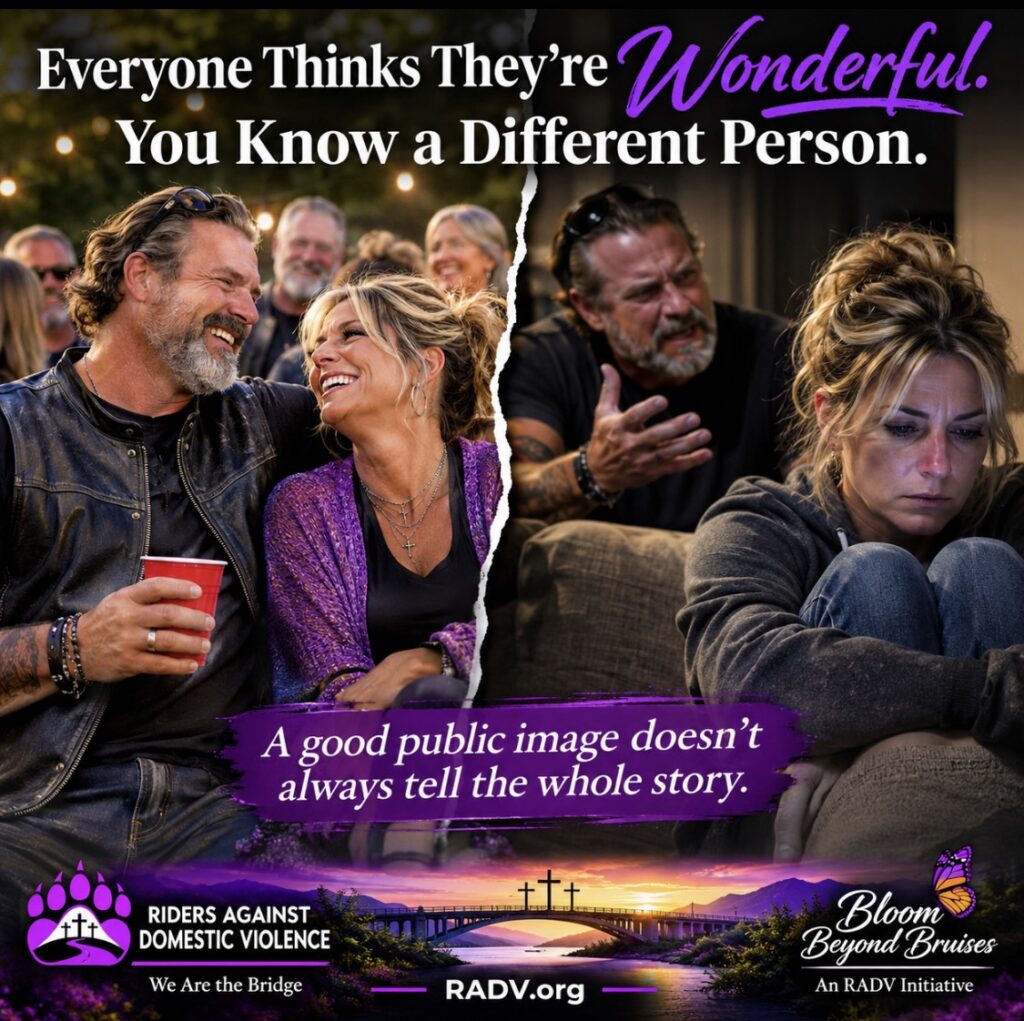
Riders Against Domestic Violence Presents
“You’re so lucky.”
You’ve heard those words more times than you can count.
At family gatherings.
At church.
At neighborhood barbecues.
From friends who tell you what a wonderful person your partner is.
And you smile.
You nod.
You say something nice.
Because what else are you supposed to say?
How do you explain that the person everyone admires isn’t always the person you live with?
How do you tell someone you’re afraid of a person they’ve never had a reason to fear?
Everyone Sees the Good Side
They’re the first person to offer help when a neighbor needs something.
They remember birthdays.
They make people laugh.
They volunteer.
They’re friendly to strangers.
People genuinely enjoy being around them.
And sometimes you watch them interacting with everyone else and wonder why things can’t be that way at home.
You see the patience they show a stranger.
The kindness they offer a coworker.
The laughter they share with friends.
And you remember when they treated you that way.
Maybe they still do sometimes.
That’s part of what makes everything so confusing.
Because the person who makes everyone laugh at dinner may be the same person who humiliates you on the drive home.
The Ride Home
You’ve just spent three hours at a family gathering.
Everyone had a wonderful time.
Your partner was charming.
They told stories.
They complimented the food.
They hugged everyone goodbye.
Someone even pulled you aside and said, “You’ve really got a good one.”
Then you get into the car.
The doors close.
And something changes.
“Why did you tell them that?”
“Did you really have to embarrass me?”
“Why were you talking to that person so much?”
You try to explain.
You weren’t trying to embarrass anyone.
You were just having a conversation.
But the more you explain, the worse things become.
So you stop talking.
You stare out the window.
And you begin replaying everything you said that evening, trying to figure out what you did wrong.
An hour ago, everyone was laughing. Now you’re afraid to say another word.
And tomorrow, those same people will tell you how wonderful your partner is.
When Nobody Believes You
Eventually, you might try telling someone.
A friend.
A family member.
Someone you trust.
You carefully explain what’s been happening.
Maybe you don’t tell them everything.
Maybe you’re embarrassed.
Maybe you’re afraid they’ll repeat what you said.
But you finally find the courage to speak.
And then you hear it.
“Really? That doesn’t sound like them.”
“They’ve always been so nice to me.”
“Are you sure you’re not misunderstanding?”
“Every couple argues.”
And suddenly, you wish you’d never said anything.
Because now you’re not only dealing with what happens at home.
You’re wondering whether anyone will ever believe you.
A person’s kindness toward you doesn’t prove how they treat someone else in private.
The Things People Don’t See
They don’t see you checking your phone repeatedly because you know there will be consequences if you miss a message.
They don’t see you changing clothes because your partner disapproves of what you’re wearing.
They don’t see you turning down invitations because you don’t want another argument.
They don’t see you asking permission for ordinary purchases because you’re afraid of being accused of wasting money.
They don’t see you carefully choosing which stories you can tell in public.
And they may never see the moment when your partner waits until you’re alone to tell you everything you supposedly did wrong.
From the outside, it can look like a wonderful relationship.
From the inside, you may feel as though you’re constantly being watched, judged, or controlled.
The Man Nobody Believes
There’s a man somewhere who has tried to explain what’s happening in his marriage.
His wife is outgoing.
She’s successful.
Everyone likes her.
She’s the person people turn to when they need help.
But at home, he experiences repeated humiliation, threats, or controlling behavior.
Maybe she monitors his spending.
Maybe she threatens to ruin his reputation if he tells anyone.
Maybe she mocks him when he becomes emotional.
And when he finally confides in someone, they laugh.
“Come on, you’re a big guy. You can handle yourself.”
So he stops talking.
He convinces himself nobody would take him seriously anyway.
But abuse isn’t determined by someone’s size, gender, or physical strength.
Men can be survivors, too. And they deserve to be believed, heard, and supported.
The Woman Who Has Learned to Smile
There’s a woman standing beside her husband at a community event.
He’s shaking hands.
Making jokes.
Talking about how important family is.
Everyone tells her what a good man he is.
She smiles for the photographs.
But she knows that later, when they’re alone, she may be questioned about what she said, whom she spoke to, or why she didn’t behave the way he expected.
She knows the smile everyone sees doesn’t tell the whole story.
And perhaps the hardest part is that she still loves him.
She remembers the good days.
She hopes things will change.
She wonders whether she’s making too much of everything.
Loving someone and being harmed by their behavior can exist at the same time.
That confusion doesn’t make a survivor foolish.
It makes their circumstances complicated.
A Good Reputation Is Not Proof of a Healthy Relationship
It’s important to recognize that nobody is perfect.
People sometimes behave differently in public than they do at home.
We all have bad days.
Couples disagree.
Stress can make people irritable or withdrawn.
Those things alone do not establish abuse.
The warning signs become more serious when there is a repeated pattern of intimidation, threats, humiliation, isolation, manipulation, or coercive control.
Abuse is often about power and control, not simply having a bad temper.
And someone can behave respectfully toward friends, coworkers, and strangers while using harmful behavior against a partner.
We should not assume someone is abusive simply because an accusation is made.
But neither should we dismiss a survivor’s concerns because the person they describe has a good reputation.
Listen carefully. Take concerns seriously. Focus on behavior and safety rather than popularity.
When Someone Finally Tells You
If someone trusts you enough to describe what happens behind closed doors, your response matters.
You don’t have to investigate.
You don’t have to confront their partner.
You don’t have to decide the future of their relationship.
Sometimes the most helpful words are simple.
“I’m glad you told me.”
“I’m sorry you’re experiencing this.”
“Do you feel safe?”
“How can I support you?”
Avoid pressuring someone to leave or demanding that they prove what happened.
If they are experiencing abuse, a trained domestic violence advocate can help them explore options and develop a safety plan.
And remember that confronting a controlling partner without the survivor’s knowledge or consent can increase danger.
Being supportive means listening, respecting their choices, and helping them access appropriate resources.
What About the Person Causing Harm?
There’s another side to this conversation.
Sometimes the person everyone admires knows exactly how to behave respectfully in public.
They can manage frustration at work.
They can disagree politely with friends.
They can remain patient with strangers.
But at home, they repeatedly intimidate, belittle, threaten, or control their partner.
If that sounds familiar, it’s worth asking yourself a difficult question.
Why am I willing to give strangers the respect I deny the person I say I love?
Stress, frustration, disappointment, and anger are real emotions.
But they don’t excuse abusive behavior.
Accountability begins with recognizing the harm, stopping the behavior, respecting boundaries, and seeking appropriate professional help.
An apology means little without sustained change.
And the person harmed is not responsible for teaching someone else how to stop abusing them.
Prevention matters.
That’s why RADV believes we must talk not only about recognizing abuse, but also about preventing harmful behavior before it becomes another person’s pain.
God Knows What Happens Behind Closed Doors
The Bible reminds us:
“The eyes of the LORD are in every place, beholding the evil and the good.” — Proverbs 15:3 (KJV)
A person’s public reputation doesn’t determine their character.
Character is also revealed in the way we treat people when nobody else is watching.
In our patience.
Our honesty.
Our willingness to accept responsibility.
Our respect for another person’s dignity.
And for the person suffering quietly behind a carefully maintained public image, remember that your worth doesn’t depend on whether others understand what you’ve experienced.
You deserve compassion.
You deserve safety.
And you deserve to be treated with respect.
To the Person Everyone Thinks Is Lucky
Maybe you’ve spent years smiling when people tell you how wonderful your partner is.
Maybe you’ve learned to keep certain things private because you’re afraid nobody will understand.
Maybe you’ve even started questioning your own experiences because everyone else sees such a different person.
I want you to remember something.
You don’t have to convince the entire world that you’re hurting before you’re allowed to seek support.
You don’t have to wait until things become worse.
You don’t have to make a life-changing decision today.
But you deserve the opportunity to speak with someone who will listen without judgment and help you understand your options.
The person everyone else knows may not be the person you experience at home.
And your experience matters.
We Are the Bridge
At Riders Against Domestic Violence, we believe survivors deserve to be heard, respected, and connected with meaningful support.
Our mission is not to judge someone by appearances or tell survivors which decisions to make.
Our mission is to help people recognize warning signs and connect with organizations equipped to assist them.
We are not a shelter or crisis hotline.
We Are the Bridge.
Visit RADV.org for survivor resources, educational articles, and information about healthy relationships and abuse prevention.
In the United States, the National Domestic Violence Hotline is available at 800-799-SAFE (7233) or thehotline.org.
And remember:
A good public image can hide private harm. When someone finds the courage to speak, let compassion be louder than disbelief.
Your story isn’t over.
Your best miles are still ahead.
💜 Riders Against Domestic Violence
We Are the Bridge.