
Riders Against Domestic Violence Presents
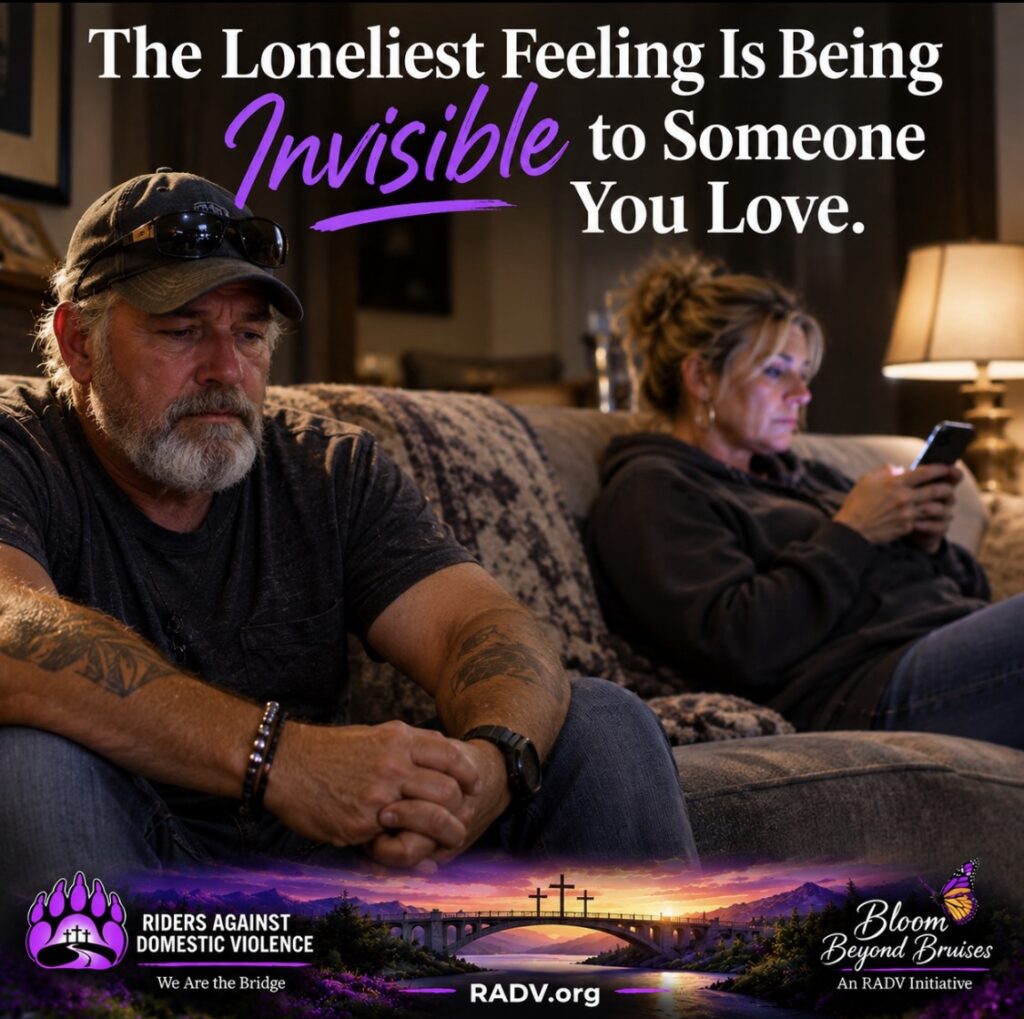
There are few things lonelier than sitting beside someone you love and feeling like you’re not even there.
They’re sitting on the couch.
You’re sitting a few feet away.
The television is on.
Maybe they’re scrolling through their phone.
You want to say something.
Anything.
You want to laugh together, share a story, or simply feel that familiar connection you once had.
But you don’t.
Because somewhere along the way, talking became difficult.
And now you’re sitting in the same room, wondering how two people who once couldn’t wait to be together became strangers living under the same roof.
Sometimes the loneliest place in the world is right beside someone you love.
When the Little Things Disappear
It isn’t always the big things you miss.
Sometimes it’s the little things.
The hand reaching for yours while you’re watching television.
The unexpected hug in the kitchen.
The smile when you walk through the door.
The phone call just to ask how your day is going.
The laughter over something silly that nobody else would understand.
Those moments might seem insignificant to someone who still has them.
But when they’ve been missing for months or years, their absence can become overwhelming.
You begin wondering whether the person you love even notices.
You might find yourself remembering when they used to reach for your hand without thinking.
And now you can’t remember the last time they did.
The Question You Become Afraid to Ask
One evening, you finally gather the courage to say something.
“I miss us.”
Three simple words.
You’re not trying to start an argument.
You’re not demanding perfection.
You’re trying to tell someone you love that you’re lonely.
But perhaps the response isn’t what you hoped for.
“Here we go again.”
“Nothing I do is ever good enough for you.”
“You’re always complaining.”
And suddenly, instead of talking about the distance between you, you’re defending yourself for bringing it up.
So you apologize.
You say it doesn’t matter.
And you promise yourself you won’t mention it again.
But it does matter.
Because the need to feel loved, valued, and emotionally connected doesn’t disappear just because someone refuses to discuss it.
You can stop talking about loneliness without ever stopping feeling it.
The Man Sitting at the Other End of the Couch
There’s a man somewhere tonight sitting in his living room.
He’s worked all day.
He’s taken care of the responsibilities that needed attention.
Maybe he’s getting older.
Maybe life hasn’t turned out quite the way he imagined.
But there’s still one thing he wants.
To feel close to the person he loves.
He doesn’t need an expensive vacation.
He doesn’t need another possession.
He’d be happy with an evening of laughter, a little affection, or someone reaching across the couch to hold his hand.
But he doesn’t know how to ask anymore.
He’s afraid of sounding needy.
He’s afraid of being rejected.
And he’s tired of feeling embarrassed for wanting something that once came so naturally.
So he sits quietly.
And nobody realizes how much he’s hurting.
Men need affection, tenderness, and emotional connection, too.
Wanting those things doesn’t make a man weak.
It makes him human.
The Woman Who Stopped Asking for Attention
There’s a woman somewhere else who remembers when her partner used to make her feel special.
They used to talk for hours.
They used to make plans.
They used to laugh together.
Now she feels as though everything else comes first.
Work.
Friends.
The phone.
The television.
Every responsibility except their relationship.
She tries to explain how lonely she feels.
But eventually she gets tired of asking.
She doesn’t want affection that feels forced.
She doesn’t want someone to hold her hand only because she begged them to.
She wants to feel wanted.
So she stops asking.
And sometimes the silence becomes more painful than the rejection.
When Emotional Distance Becomes Something More
It’s important to understand that emotional distance alone doesn’t necessarily mean someone is abusive.
Relationships experience difficult seasons.
Illness, depression, grief, financial pressure, exhaustion, and unresolved disagreements can affect affection and communication.
Nobody owes another person physical intimacy, and everyone has the right to personal boundaries.
But there’s a difference between struggling to connect and deliberately using emotional withdrawal to punish, intimidate, or control someone.
When a person repeatedly withholds communication as punishment, humiliates their partner for expressing needs, threatens abandonment to gain compliance, or uses affection as a tool of manipulation, those behaviors may be part of emotional abuse.
The larger pattern matters.
Healthy relationships make room for honest conversations, mutual respect, and the freedom to express feelings without fear.
Love doesn’t mean two people must agree on everything. It means both people deserve to be treated with dignity.
The Pain of Feeling Unwanted
One of the hardest things about emotional disconnection is what it can do to your sense of worth.
You begin wondering whether you’re attractive anymore.
Whether you’re interesting.
Whether you’re too old.
Whether you’ve become a burden.
Whether there’s something wrong with you.
And if your feelings are repeatedly dismissed or mocked, those doubts can grow.
You may begin believing that your need for affection is unreasonable.
That wanting someone to listen makes you demanding.
That asking for kindness makes you difficult.
But the desire for emotional connection is a normal human need.
You deserve to be able to express that need respectfully.
And you deserve to have your feelings taken seriously, even when another person cannot meet every expectation.
Your worth is not measured by how much attention someone gives you.
When You Begin Feeling Invisible to Yourself
Sometimes the hardest part isn’t that someone else has stopped noticing you.
It’s that you’ve stopped noticing yourself.
You don’t make plans anymore.
You don’t pursue the things that once brought you happiness.
You spend your days hoping someone will finally recognize how lonely you’ve become.
And slowly, your entire sense of happiness begins depending on whether they acknowledge you.
That’s an exhausting way to live.
You deserve friendships.
You deserve interests.
You deserve opportunities to grow.
You deserve moments of joy that don’t depend entirely on another person’s approval.
Rebuilding those parts of your life isn’t about punishing someone or giving up on a relationship.
It’s about remembering that you are a whole person whose life has value.
If emotional distance is accompanied by intimidation, threats, isolation, or controlling behavior, consider speaking privately with a trained domestic violence advocate before making changes that could affect your safety.
God Sees the Person Who Feels Forgotten
The Bible tells us:
“The LORD is nigh unto them that are of a broken heart; and saveth such as be of a contrite spirit.” — Psalm 34:18 (KJV)
There are moments when loneliness makes us feel forgotten.
When we wonder whether anyone sees the sadness behind our smile.
When we pray for things to change but don’t know what tomorrow will bring.
Faith doesn’t promise that every relationship will become what we hoped it would be.
But it can remind us that our worth is not determined by another person’s attention.
You are not invisible.
Your feelings matter.
Your life matters.
And your future still holds possibilities.
To the Person Sitting Alone Beside Someone They Love
I don’t know what your relationship looks like.
I don’t know how long you’ve been feeling lonely.
Maybe you’re going through a difficult season that both of you want to repair.
Maybe you’ve tried talking, but neither of you knows how to reconnect.
Or maybe you’re living with a pattern of emotional cruelty or control that has left you afraid to express yourself.
Those situations are different, and they deserve different kinds of support.
But whatever your circumstances, I want you to remember something.
You should never have to surrender your dignity to receive kindness.
You are allowed to want companionship.
You are allowed to express loneliness.
You are allowed to hope for affection and connection.
And you are allowed to seek support when your relationship is hurting you.
Maybe the road forward involves rebuilding communication.
Maybe it involves professional counseling when both people can participate safely and respectfully.
And if abuse is present, individual support from a trained advocate may be the safer place to begin rather than couples counseling.
You don’t have to make every decision today.
But you don’t have to ignore your own pain, either.
Being loved should never require you to become invisible.
We Are the Bridge
At Riders Against Domestic Violence, we believe everyone deserves relationships built on dignity, respect, and safety.
We recognize that not every struggling relationship is abusive, but we also understand how deeply emotional abuse can affect a person’s life.
Our mission is to connect survivors with trusted resources and organizations that can help them explore their options.
We are not a shelter or crisis hotline.
We Are the Bridge.
Visit RADV.org to explore survivor resources.
In the United States, the National Domestic Violence Hotline is available at 800-799-SAFE (7233) or thehotline.org.
And to the person who feels invisible tonight:
You deserve to be seen, heard, respected, and valued.
Your story isn’t over.
Your best miles are still ahead.
💜 Riders Against Domestic Violence
We Are the Bridge.