Riders Against Domestic Violence Presents
There was a time when you laughed without thinking about it.
You walked into a room with confidence.
You made decisions without second-guessing yourself.
You had dreams, opinions, friendships, and things that made you happy.
You knew who you were.
But somewhere along the way, something changed.
And the frightening part is that you can’t remember exactly when it happened.
Maybe it started with a few hurtful comments.
Maybe it was the criticism that seemed to come no matter how hard you tried.
Maybe it was the arguments that always ended with you apologizing, even when you weren’t sure what you’d done wrong.
Or maybe it was the slow realization that the person you loved had become someone you were afraid to disappoint.
One day, you looked in the mirror and barely recognized the person looking back.
And quietly, perhaps without telling another soul, you asked yourself:
“What happened to me?”
The Person Everyone Else Still Sees
Here’s something people don’t always understand about emotional abuse.
From the outside, your life might look perfectly normal.
You go to work.
You pay your bills.
You take care of your children.
You smile when someone asks how you’re doing.
You attend family gatherings, celebrate birthdays, and show up for the people who depend on you.
And when someone asks whether everything is okay, you give the answer you’ve practiced a thousand times.
“I’m fine.”
But you’re not fine.
You’re exhausted.
Not because you haven’t slept enough.
Because you’ve spent so much time trying to avoid conflict that you no longer know how to relax.
You listen carefully to someone’s tone of voice.
You notice their footsteps.
You recognize the sound of a door closing harder than usual.
You can sometimes tell what kind of evening you’re going to have before a single word has been spoken.
And you begin adjusting your behavior accordingly.
You become quieter.
More careful.
More agreeable.
Not necessarily because you’ve changed your mind.
But because you’ve learned that keeping the peace sometimes feels easier than explaining yourself.
And slowly, the person you used to be begins disappearing behind the person you’ve learned you need to become.
When Love Starts Feeling Like Something You Have to Earn
There is something deeply painful about trying to earn affection from someone you love.
You tell yourself that if you work a little harder, things will improve.
If you stop making mistakes, maybe the criticism will end.
If you become more understanding, maybe they’ll become more affectionate.
If you avoid bringing up your feelings, maybe tonight will be peaceful.
So you keep trying.
You give a little more.
You ask for a little less.
You convince yourself that tomorrow might be different.
And sometimes tomorrow is different.
There are good days.
There are moments of laughter.
There are reminders of the person you fell in love with.
Those moments can make everything confusing.
Because you find yourself holding on to the good days while trying to understand the painful ones.
But love should never require someone to surrender their dignity, independence, or sense of self.
You should not have to become smaller so someone else can feel bigger.
The Pain Nobody Sees
Sometimes the most heartbreaking moments happen when nobody else is around.
Sitting on the edge of the bed after another argument.
Standing in the shower longer than necessary because it’s the only place you can cry privately.
Driving home from work and sitting in the driveway because you need a few more minutes before going inside.
Lying beside someone you love while feeling completely alone.
And perhaps the hardest part is remembering that you weren’t always this way.
You used to laugh more.
You used to look forward to things.
You used to believe in yourself.
Now you question almost everything.
Was that really what happened?
Am I overreacting?
Am I too sensitive?
Is everything somehow my fault?
When someone repeatedly dismisses your feelings, distorts events, humiliates you, or uses intimidation and control, the emotional effects can be profound.
Over time, you may begin questioning your own judgment.
And the confidence you once carried so naturally can become something you struggle to find.
Not Every Difficult Relationship Is Abuse
This distinction matters.
Every relationship experiences difficult seasons.
People become stressed, distracted, frustrated, and emotionally distant.
Couples disagree.
Sometimes they hurt each other’s feelings.
Sometimes communication breaks down.
Those experiences alone do not necessarily mean a relationship is abusive.
But repeated patterns of intimidation, manipulation, humiliation, threats, coercion, or controlling behavior are different.
When someone uses fear to influence your choices, deliberately undermines your confidence, isolates you from support, or punishes you for expressing your feelings, those are warning signs that deserve serious attention.
Abuse is not defined by whether someone occasionally behaves badly.
We must look at the larger pattern of behavior, particularly the use of power and control.
And we must remember that abuse can happen to anyone.
Women and men.
Young people and older adults.
People with money and people struggling financially.
People who appear confident and people who have always been quiet.
There is no single face of a survivor.
And Yes, Men Experience This Too
There is a man somewhere reading these words who hasn’t told anyone what life is really like behind his front door.
He goes to work.
He provides for his family.
He handles responsibilities.
He tries to be strong because that’s what he was taught a man is supposed to do.
But at night, when nobody is watching, he wonders what happened to the person he used to be.
Maybe he’s embarrassed to talk about it.
Maybe he believes nobody would take him seriously.
Maybe he’s afraid someone will laugh.
Or maybe he simply doesn’t have the words to explain what’s happening.
To that man, I want to say something.
Your pain matters, too.
You do not have to prove your strength by suffering in silence.
You deserve dignity, respect, and safety just as much as anyone else.
And asking for support does not make you less of a man.
It makes you someone who recognizes that your well-being matters.
Finding the Person You Used to Be
Here’s what I want every survivor to understand.
The person you remember hasn’t necessarily disappeared.
They may be buried beneath years of stress, fear, criticism, and emotional exhaustion.
They may have forgotten what it feels like to make a decision without worrying about someone’s reaction.
They may have stopped doing the things they once enjoyed.
They may have lost touch with friends, interests, and dreams.
But rebuilding is possible.
It doesn’t happen overnight.
Sometimes it begins with something small.
Calling an old friend.
Taking a walk.
Writing down your thoughts.
Speaking with a counselor or advocate.
Making one decision for yourself.
Or simply admitting that the way you’ve been living is hurting you.
If you’re experiencing abuse, a trained advocate can help you explore your options and consider your safety before making changes that might increase risk.
You don’t have to solve everything today.
You don’t have to make decisions before you’re ready.
And you don’t have to walk the road alone.
God Has Not Forgotten Who You Are
There is a verse that speaks beautifully to people who feel broken by what they’ve experienced.
“The LORD is nigh unto them that are of a broken heart; and saveth such as be of a contrite spirit.” — Psalm 34:18 (KJV)
Sometimes life leaves us feeling so defeated that we begin to believe our best days are behind us.
But pain does not erase your worth.
Someone else’s treatment of you does not determine your value.
And the difficult chapter you’re living through does not have to define the rest of your story.
There is still a future worth believing in.
There is still hope.
And there is still a person inside you who deserves the opportunity to live without fear.
A Message to the Person Reading This
If you’ve been sitting alone wondering what happened to the person you used to be, I want you to hear something.
You are not foolish for having loved someone.
You are not weak because you’ve struggled.
You are not a failure because your life hasn’t turned out the way you imagined.
And you are not required to prove your suffering to deserve compassion.
Maybe today you don’t feel strong.
Maybe you don’t feel confident.
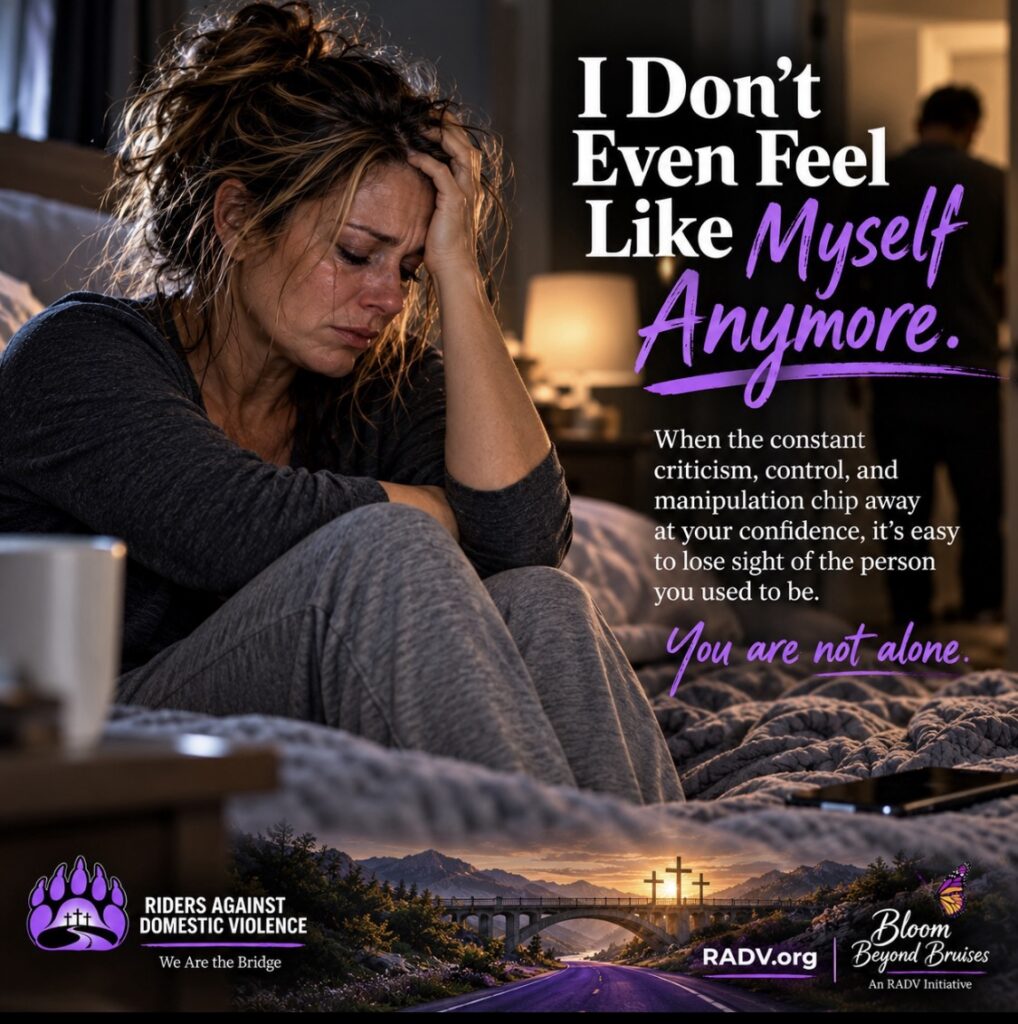
Maybe you don’t even recognize yourself anymore.
That’s okay.
You don’t have to become your old self overnight.
In fact, you may discover that the person you’re becoming is someone new.
Someone who understands their worth.
Someone who knows their voice matters.
Someone who recognizes the difference between love and control.
Someone who no longer believes peace must come at the expense of their dignity.
You are still here.
And that means your story is still being written.
We Are the Bridge
At Riders Against Domestic Violence, we believe every survivor deserves access to information, compassion, and meaningful support.
We are not a shelter or crisis hotline.
We are a bridge connecting survivors with resources and organizations that can help them find their next steps.
Whether you’re beginning to recognize warning signs, trying to understand what you’ve experienced, or rebuilding your life after abuse, you deserve to know that help exists.
Visit RADV.org to explore survivor resources.
If you are in immediate danger, contact emergency services when it is safe to do so.
In the United States, the National Domestic Violence Hotline is available at 800-799-SAFE (7233) or through thehotline.org.
And remember this:
You may not feel like yourself today.
But you are still worthy of love, respect, safety, and happiness.
Your story isn’t over.
Your best miles are still ahead.
💜 Riders Against Domestic Violence
We Are the Bridge.