
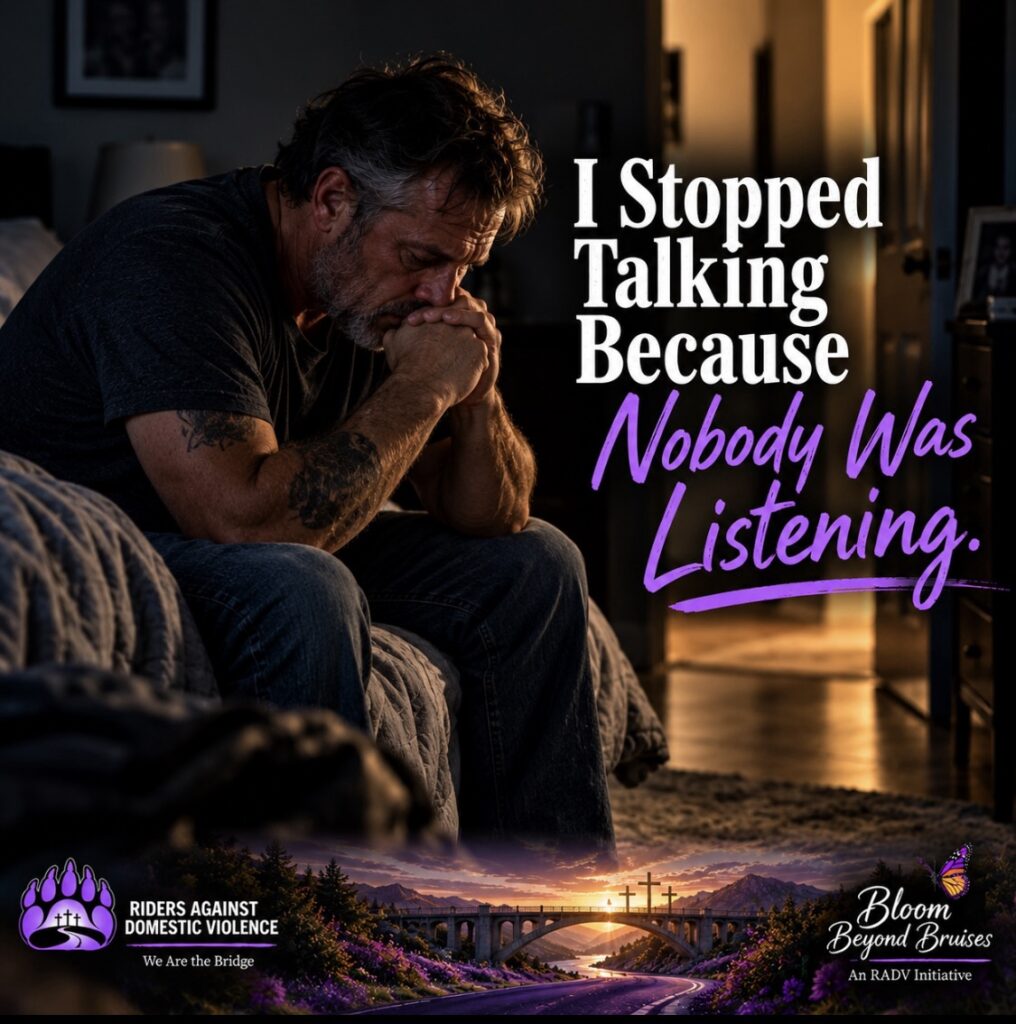
Riders Against Domestic Violence Presents
Have you ever started to say something, then stopped yourself because you already knew how the conversation would end?
You had something on your mind.
Something that bothered you.
Something you wanted to explain.
Maybe you were hurt by something someone said.
Maybe you felt ignored.
Maybe you simply wanted to talk about how unhappy you’d been feeling.
But before the words could leave your mouth, you started thinking.
Is this really worth bringing up?
Will they get angry?
Will they turn everything around on me?
Will I spend the rest of the evening wishing I’d never said anything?
So you swallowed the words.
You smiled.
You said everything was fine.
And you went back to whatever you were doing.
But everything wasn’t fine.
You were just tired of trying to explain why you were hurting.
When You Start Rehearsing Conversations
There’s something heartbreaking about standing in the shower, driving to work, or lying awake at night practicing a conversation you haven’t even had yet.
You imagine what you’ll say.
You carefully choose your words.
You try to find a way to express yourself without sounding angry, demanding, or ungrateful.
You think about every possible response.
And sometimes, after all that preparation, you decide not to say anything at all.
Because you’ve learned that even the smallest conversation can turn into something exhausting.
You might be accused of starting an argument.
You might be told you’re too sensitive.
You might hear that you’re imagining things.
Or you might find yourself apologizing for bringing up something that hurt you in the first place.
Eventually, you begin believing that silence is the only way to keep the peace.
But there’s a difference between choosing peace and being afraid to speak.
The Things You Stop Saying
At first, you stop mentioning the little things.
You don’t say when a comment hurts your feelings.
You don’t explain why something upset you.
You don’t ask why affection seems to have disappeared.
You don’t mention that you’re lonely.
Then something else begins to happen.
You stop sharing the good things, too.
You don’t talk about an idea you’re excited about because you’re afraid it will be criticized.
You don’t mention something you’d like to buy because you don’t want another argument.
You stop talking about your dreams because you’ve grown accustomed to hearing why they won’t work.
And slowly, the conversations that once made you feel connected become little more than discussions about bills, chores, schedules, and responsibilities.
You begin living beside someone instead of feeling connected to them.
And sometimes you wonder whether they even notice how quiet you’ve become.
When Silence Becomes a Survival Strategy
Not every quiet relationship is abusive.
Some people naturally communicate less. Some couples struggle with emotional distance, stress, or unresolved disagreements.
But when someone repeatedly uses intimidation, threats, humiliation, manipulation, or controlling behavior to silence another person, that is something far more serious.
For someone experiencing emotional abuse, remaining quiet may become a way of avoiding escalation.
They learn which subjects to avoid.
They watch someone’s facial expressions.
They listen for changes in tone.
They become unusually careful about ordinary decisions.
And they may begin measuring every word against the possibility of an angry or punishing response.
This isn’t simply poor communication.
When silence is driven by fear and an ongoing pattern of coercion or control, it may be a sign of abuse.
And the emotional consequences can last long after a particular argument has ended.
The Man Nobody Thinks to Ask
Somewhere tonight, there’s a man sitting in his garage.
Maybe he’s pretending to work on his motorcycle.
Maybe he’s organizing tools that don’t need organizing.
Maybe he’s sitting in his truck with the radio playing quietly.
He’s not necessarily avoiding responsibility.
He may simply be trying to find a few minutes when nobody expects anything from him.
He goes to work.
He pays bills.
He takes care of the things that need fixing.
And when someone asks how things are going, he says:
“Can’t complain.”
But he could.
He has plenty he wishes he could talk about.
He just doesn’t know who would listen.
Men can experience emotional abuse, intimidation, and coercive control, too.
And the expectation that men should always be strong can make asking for help especially difficult.
Being a man doesn’t mean you have to suffer in silence.
Your feelings matter.
Your safety matters.
And you deserve to be treated with dignity.
The Woman Who Keeps Everything Together
And somewhere else, there’s a woman sitting at the kitchen table after everyone has gone to bed.
The dishes are done.
The children are asleep.
Tomorrow’s lunches are ready.
She’s exhausted, but her mind won’t stop.
She’s thinking about something that happened earlier.
A comment.
An accusation.
A conversation that left her feeling small.
She wants to talk about it.
But she remembers what happened the last time she tried.
So instead, she sits quietly.
Maybe she cries.
Maybe she tells herself tomorrow will be better.
Maybe she wonders how much longer she can keep pretending everything is okay.
To that woman, I want to say:
You deserve to be heard without being frightened into silence.
You deserve respect.
And you deserve support that honors your choices.
What Happens When You Finally Speak?
Sometimes, after months or years of holding everything inside, a person reaches a breaking point.
They cry.
They become frustrated.
They raise their voice.
They finally say they’ve had enough.
And suddenly, the attention shifts to their reaction.
People ask why they became so upset.
Why they couldn’t remain calm.
Why they didn’t say something sooner.
But sometimes the better question is:
What made this person feel they couldn’t speak openly in the first place?
That doesn’t mean every emotional reaction is justified or that harmful behavior should be excused.
It means we need to understand the full pattern of a relationship rather than judging one isolated moment.
Survivors deserve to have their experiences understood, not reduced to the moment when their emotions became visible.
Finding Your Voice Again
If you’ve spent a long time feeling afraid to express yourself, finding your voice again may not be easy.
You may second-guess yourself.
You may feel guilty for setting boundaries.
You may worry that asking for something you need makes you selfish.
But your feelings deserve consideration.
You are allowed to have opinions.
You are allowed to disagree.
You are allowed to say that something hurt you.
And you are allowed to seek support.
If you’re experiencing intimidation or coercive control, speaking up directly or confronting an abusive partner may not always be safe. A trained domestic violence advocate can help you consider your circumstances and explore safer options.
You don’t have to prove your courage by putting yourself in danger.
Sometimes finding your voice begins with telling one trusted person what you’ve been experiencing.
Sometimes it begins with writing down feelings you’ve never spoken aloud.
And sometimes it begins with realizing that you deserve a life where expressing yourself doesn’t feel dangerous.
A Message of Faith
The Bible reminds us:
“God is our refuge and strength, a very present help in trouble.” — Psalm 46:1 (KJV)
There may be moments when you feel as though nobody hears what you’re trying to say.
When your prayers seem to be the only place you can express what you’re carrying.
But your worth is not measured by how much pain you can endure without speaking.
You were created with dignity.
Your life has value.
And you deserve compassion, respect, and safety.
Faith can provide strength during difficult times, and seeking practical help is not a failure of faith.
Sometimes the road forward begins with allowing someone trustworthy to walk beside you.
To the Person Who Has Been Quiet for Too Long
I don’t know what your home looks like.
I don’t know what conversations you’ve been afraid to have.
I don’t know how many nights you’ve spent lying awake, wishing things could be different.
But I want you to hear this.
You are not weak because you’re tired.
You are not selfish because you have feelings.
You are not difficult because you want respect.
And you are not asking too much when you want to feel emotionally and physically safe.
Maybe you’ve spent years trying to keep everyone else happy.
Maybe you’ve forgotten what it feels like to speak without fear.
Maybe you don’t even know where to begin.
That’s okay.
You don’t have to figure everything out today.
You don’t have to make a life-changing decision before you’re ready.
But you deserve to know that your voice still matters.
And silence should never be the price you have to pay for peace.
We Are the Bridge
At Riders Against Domestic Violence, we understand that recognizing abuse and finding support can be difficult.
We’re not here to tell survivors what choices to make.
We’re here to connect them with information, resources, and organizations that can help them explore their options.
Whether you’re a woman, a man, or someone who has spent years believing nobody would understand, you deserve to know that help exists.
Visit RADV.org to explore survivor resources.
In the United States, the National Domestic Violence Hotline is available at 800-799-SAFE (7233) or thehotline.org.
And remember:
You were never meant to disappear just to keep someone else comfortable.
Your story isn’t over.
Your best miles are still ahead.
💜 Riders Against Domestic Violence
We Are the Bridge.