
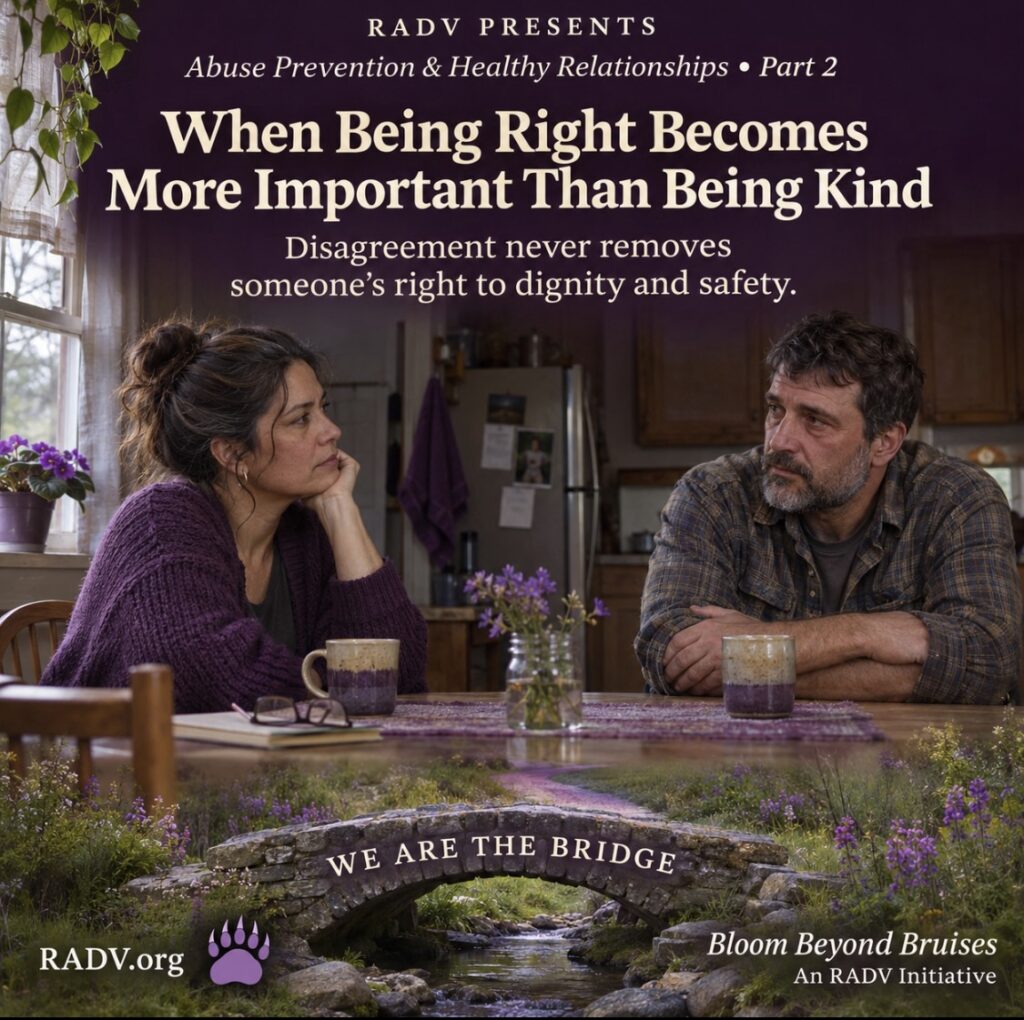
Abuse Prevention & Healthy Relationships — Part 2
The conversation started with something small.
A bill. A change of plans. Something that didn’t get done.
Your partner began explaining how they felt, but somewhere along the way, you stopped listening. You were already preparing your answer.
You remembered the details that supported your side. You brought up something they had done last week. You explained why your reaction made sense.
Eventually, they stopped talking.
And perhaps you thought that meant they understood.
But did they feel heard—or did they simply decide it was safer to be quiet?
When a conversation becomes a contest
Most of us know what it feels like to want to defend ourselves.
Being misunderstood hurts. Criticism can sting. Admitting that we handled something badly can be uncomfortable.
But there is a point where defending our perspective can become dismissing someone else’s humanity.
We interrupt every explanation.
We mock the way they express themselves.
We bring up their insecurities because we know those words will hurt.
We insist the conversation cannot end until they admit we are right.
Then we tell ourselves we were only trying to make a point.
A point is never more important than another person’s dignity.
You can disagree with someone’s account of what happened without humiliating them. You can explain your intentions while accepting that your behavior caused harm.
Being right about a detail does not excuse being cruel
Imagine your partner says:
“You embarrassed me when you spoke to me that way in front of everyone.”
Your first response might be:
“That’s not exactly what I said.”
Perhaps their recollection is imperfect. Perhaps yours is too.
But correcting a word does not address the concern they brought to you.
A more responsible response could be:
“I remember some of the words differently, but I did make that joke about you. It was disrespectful, and I’m sorry.”
You do not have to confess to something you did not do. You do need to examine what you actually did.
An honest conversation leaves room for facts, feelings, and responsibility.
Disagreement and abuse are not the same
Two people can disagree strongly and still respect each other’s freedom.
They can say no. They can ask for space. They can have different opinions without facing punishment.
Abuse involves harm such as intimidation, coercion, threats, or control. It may happen in a quiet voice. A person can sound perfectly calm while threatening to take away access to money or making their partner afraid to leave the room.
The National Domestic Violence Hotline identifies power and control as central to domestic abuse.
A useful question is not simply, “Did we argue?”
It is:
“Can each person disagree, set a boundary, or end this conversation without fear?”
A single act of violence, sexual coercion, or a serious threat can be abuse. Nobody has to wait for it to happen again before seeking support.
Listen to the explanations you give yourself
Sometimes harmful behavior comes wrapped in words that make it sound reasonable.
“I’m just being honest.”
“They need to learn.”
“If they would listen, I wouldn’t have to repeat myself.”
“I never touched them.”
Honesty does not require humiliation.
Disagreement does not give us authority to punish another adult.
And the absence of physical violence does not mean someone feels safe.
When we believe our frustration gives us the right to control another person, we have something serious to address.
A different way to respond
In relationships where both people can safely speak and set boundaries, these practices can help make disagreement more respectful:
1. Let the other person finish.
Notice when you are preparing a rebuttal instead of listening. You can ask, “Have I understood what you’re saying?” without agreeing with every detail.
2. Name your own behavior clearly.
“I interrupted you and called you a name” is more accountable than “Things got out of hand.”
Be specific about your choices.
3. Respect the right to stop.
Nobody owes you an immediate conversation or an admission that you are right. Do not follow someone from room to room, block their exit, take their phone, or keep sending messages until they respond.
4. Separate a request from a demand.
You can ask for something. The other person must remain free to decline without retaliation.
5. Make your next action match your apology.
If you apologize for insulting someone, the work is to stop using insults—including when you are disappointed, embarrassed, or convinced you are right.
These practices are not a treatment for abuse. When intimidation or control is already happening, specialized abuse-intervention support is needed.
Kindness does not mean surrendering your boundaries
This message must never become another way to silence someone who is being harmed.
“Be kind” does not mean agree to unwanted intimacy.
It does not mean hand over your passwords, tolerate threats, or stay in an unsafe relationship.
It does not mean that a survivor must speak gently enough to prevent someone else’s abuse.
A person who is frightened may cry, become angry, or struggle to explain what happened. Their distress does not erase the harm they experienced.
You do not lose your right to safety because you could not find perfect words.
What Scripture teaches us
“Let all your things be done with charity.”
— 1 Corinthians 16:14 (KJV)
That instruction reaches beyond the easy moments.
It asks us to consider how we behave when we are disappointed. How we speak when we feel challenged. What we do when another person’s answer is not the one we wanted.
For those of us guided by faith, love should be visible in our willingness to listen, respect boundaries, tell the truth, and accept responsibility.
Scripture must never be used to demand submission to harm or pressure someone to reconcile.
Faith can call us to change our own conduct. It does not give us ownership of another person.
One honest question for today
Think privately about a recent disagreement and ask:
“What did I do when the other person did not agree with me?”
Did you allow them to have a different view?
Did you respect their request for space?
Or did you keep pushing until they gave in?
This reflection is about your own conduct. It is not a test to administer to your partner or a reason to demand that they discuss the relationship.
If you recognize intimidation, threats, or controlling behavior in yourself, take that recognition seriously. Seek specialized help. Do not make your partner responsible for finding it, supervising you, or staying while you work on it.
There is more to protect than your pride
A healthy relationship needs room for two voices.
Two perspectives.
Two people whose dignity does not depend on agreeing.
The next time you feel determined to have the last word, pause long enough to consider what your words are doing.
Are you explaining yourself?
Or are you trying to make it impossible for the other person to disagree?
You can stand by your perspective while choosing respect. You can acknowledge harm without losing your worth. You can take responsibility without demanding reassurance in return.
At RADV, we believe prevention includes these honest conversations—and the actions that follow them.
Because the person beside you deserves to be safe, even when you disagree.
Support and next steps
If you are concerned about your own harmful behavior, learn about specialized intervention:
https://www.thehotline.org/resources/intervention-programs-for-abusive-behavior/
If you are experiencing abuse, you do not have to confront your partner or share this article with them. Explore support at:
https://radv.org/find-help/
Continue the RADV Abuse Prevention & Healthy Relationships series:
https://radv.org/abuse-prevention-healthy-relationships/
RADV provides education and connections to resources. It is not an emergency service or treatment program.
Riders Against Domestic Violence
We Are the Bridge.
A bridge to a flowering bloom beyond bruises.